The Cultured Cook by Michelle Schoffro Cook
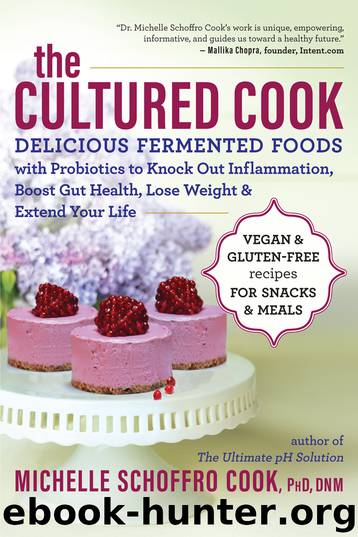
Author:Michelle Schoffro Cook
Language: eng
Format: epub
Publisher: New World Library
Basic Sauerkraut
When it comes to probiotic-rich foods, yogurt gets all the fanfare, but sauerkraut with live cultures contains a wider variety of probiotic strains and, arguably, more health benefits. But why choose between the two when you can enjoy both foods?
Sadly, the art of making homemade sauerkraut has dwindled over the years. Most people wrongly assume that it takes a lot of work and is difficult to make, but it actually requires minimal effort and is quite simple once you get used to it.
The following recipe is for making a simple sauerkraut without the many possible flavor additions. It is delicious on its own, but feel free to add a handful of flavor additions, such as caraway seeds, fennel seeds, coriander seeds, juniper berries, fresh basil, fresh or dried rosemary, mustard seeds, or others. Use your imagination if you want to try different flavors of sauerkraut, but feel free to also enjoy this simple sauerkraut recipe as is because it has a great flavor all on its own.
The description below may seem intensive, but once you get used to the basic process, it’s actually very easy. The technique to make probiotic-rich vegetable dishes usually involves brining, a process in which vegetables are fermented in a saltwater solution — brine is simply the saltwater solution. The salt draws water out of the cabbage and helps protect the vegetables from microorganisms that decompose food. Many probiotic bacteria still grow in the salt solution; however, if you use too much salt, then no microorganisms can survive and fermentation won’t take place.
You can use a variety of fermentation vessels, ranging from small to large stoneware crocks, ceramic or glass bowls, or wide-mouthed mason jars. Avoid using metal or plastic containers, as these will cause the level of acidity to increase, which can result in a chemical reaction with the metal or plastic. The probiotics are destroyed by the metal, while the plastic can leech into the food, resulting in unsafe chemical exposure. Many plastics, even ones free from bisphenol A, still contain toxic, hormone-disrupting ingredients that are best avoided. Additionally, most beneficial microbes do not grow well in a metal container, so they are best avoided. Glass, ceramic, or stoneware are best.
Download
This site does not store any files on its server. We only index and link to content provided by other sites. Please contact the content providers to delete copyright contents if any and email us, we'll remove relevant links or contents immediately.
Whiskies (Collins Gem) by dominic roskrow(45283)
101 Whiskies to Try Before You Die by Ian Buxton(45050)
World's Best Whiskies by Dominic Roskrow(44942)
Whiskies Galore by Ian Buxton(42012)
The Fast Metabolism Diet Cookbook by Haylie Pomroy(21143)
Chic & Unique Celebration Cakes by Zoe Clark(20063)
Craft Beer for the Homebrewer by Michael Agnew(18245)
The Bone Broth Miracle: How an Ancient Remedy Can Improve Health, Fight Aging, and Boost Beauty by Ariane Resnick(16610)
For the Love of Europe by Rick Steves(14121)
Tools of Titans by Timothy Ferriss(8393)
A Court of Wings and Ruin by Sarah J. Maas(7843)
Chowders and Soups by Liz Feltham(7561)
How to Be a Bawse: A Guide to Conquering Life by Lilly Singh(7486)
The Institute by Stephen King(7036)
Cravings: Recipes for All the Food You Want to Eat by Chrissy Teigen & Adeena Sussman(6788)
Wiseguy by Nicholas Pileggi(5782)
The Last Wish (The Witcher Book 1) by Andrzej Sapkowski(5467)
Spare by Prince Harry The Duke of Sussex(5194)
Room 212 by Kate Stewart(5119)
